The Odyssey leak was not an X problem
A full, high-quality copy of Christopher Nolan’s The Odyssey reached 2.1 million views on X in roughly two and a half hours. Universal removed it. The harder question remained open: which authorised copy escaped first?
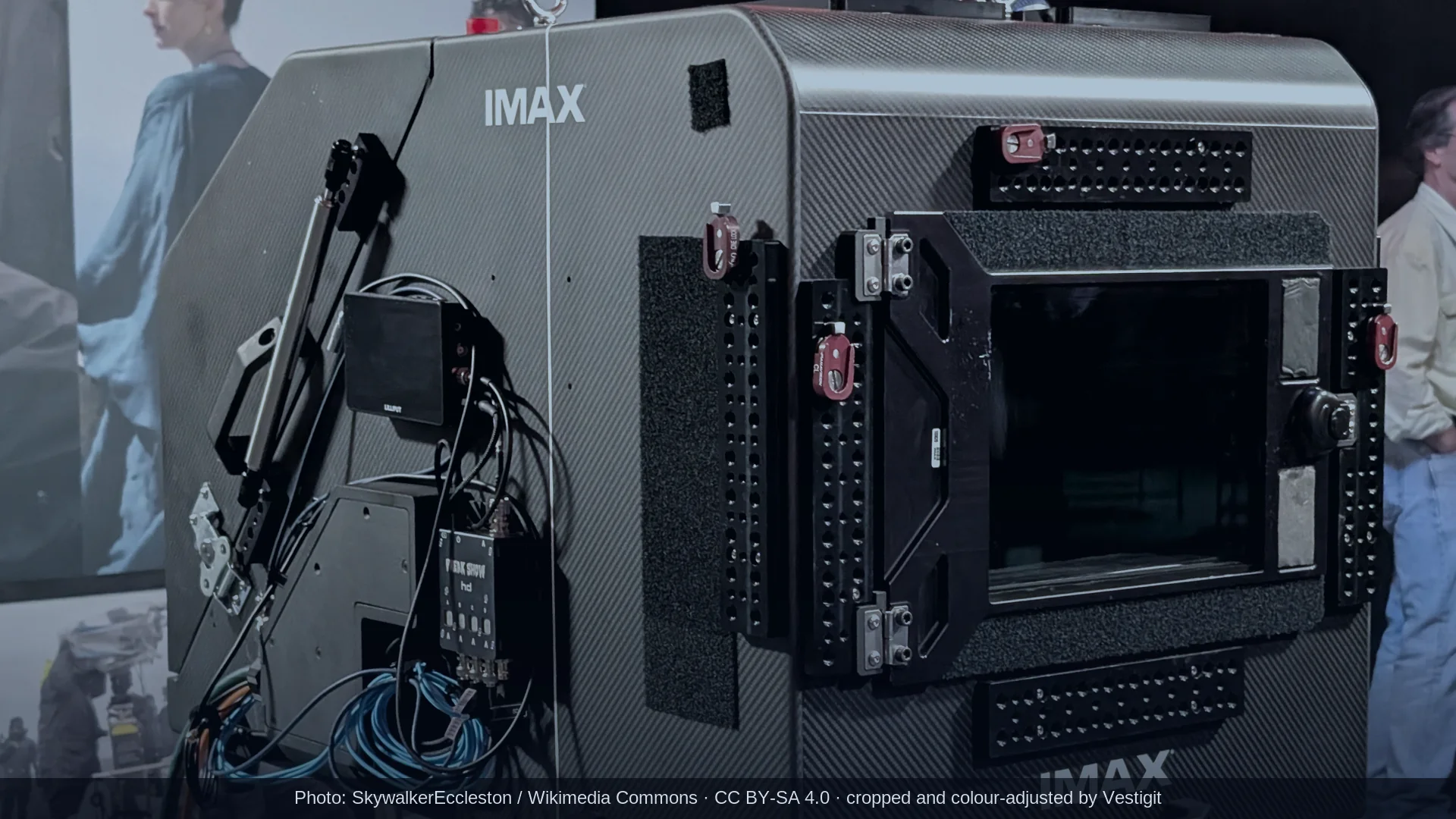
Image: SkywalkerEccleston, “IMAX Blimp 2026”, via Wikimedia Commons, licensed under CC BY-SA 4.0. Cropped and colour-adjusted by Vestigit; this adaptation remains licensed under CC BY-SA 4.0.
A full-length, high-quality version of Christopher Nolan’s The Odyssey appeared on X during the film’s theatrical run. The upload reached more than 2.1 million views in approximately two and a half hours before it was replaced with a takedown notice and the account was suspended. Universal Pictures said it had immediately initiated its takedown protocols and would pursue the remedies available to protect its content.
That was the visible response, and it was necessary. It was not, however, the same thing as identifying the source of the leak.
Public reporting has not established whether the copy originated from a cinema, a distribution asset, a promotional or review copy, an internal workflow, or another authorised point in the chain. The high quality of the material may invite speculation, but quality alone does not prove where a copy came from. As of publication, the origin remains publicly unknown.
That uncertainty is not a footnote to the incident. It is the incident.
Which authorised copy became the first unauthorised copy?
The full-film leak was not the first warning
The July 2026 upload was not the first time material from The Odyssey moved beyond its intended audience.
In July 2025, a 70-second teaser intended to play exclusively in cinemas began circulating on X and TikTok during its theatrical rollout. In December, recordings of an IMAX prologue also appeared online after the footage entered cinemas. By the time the complete film surfaced in July 2026, the production had already demonstrated the same basic pattern twice: every time valuable material was shown to a new authorised audience, another opportunity for an uncontrolled copy appeared.
The problem was therefore larger than one upload, one anonymous account or one platform’s moderation speed.
It was a content supply-chain problem.
Why can a heavily protected film still leak?
Because content protection is not one wall.
A major production moves through editing, visual effects, sound, colour grading, subtitling, dubbing, localisation, mastering, quality control, internal review, publicity, awards screening, regional distribution, cinema exhibition, home entertainment and eventually OTT delivery.
Each stage has a legitimate reason to access the content. Each access path also creates another location, system, recipient or playback environment from which the material may escape.
The Motion Picture Association’s Trusted Partner Network exists precisely because film and television security extends across companies, applications, cloud environments, physical facilities and work-from-home workflows from script to screen. MovieLabs likewise treats watermarking as one element in a broader protection stack that also includes DRM, cryptography, secure media pipelines, playback controls, revocation and device security.
Those controls are complementary because they answer different questions.
| Control | What it is designed to do | What it cannot answer alone after a leak |
|---|---|---|
| Encryption and DRM | Restrict access and control authorised playback | Which authorised playback or copy became the pirate source |
| Access controls and logging | Record who entered a system or downloaded an asset | Which of several accessed copies was ultimately redistributed |
| Vendor assessments and security procedures | Reduce the probability of a breach or misuse | Which specific workflow failed once an incident has occurred |
| Monitoring and takedowns | Find and remove publicly available pirate copies | Who supplied the first copy and whether the same source remains active |
| Forensic watermarking | Assign an invisible identity to a copy, recipient, partner or session | By itself, who physically uploaded the file; that still requires logs and investigation |
Watermarking is not a replacement for the first four layers. It is the layer that remains useful when one or more of them have already failed.
What do the biggest film and television leaks have in common?
The history of high-profile leaks shows that there is no single weak point.
| Stage | Public case | What happened |
|---|---|---|
| Post-production facility | Star Wars: Episode III – Revenge of the Sith | A worker took a copy from the post-production facility where he worked. It passed through several people before being uploaded one day before the worldwide theatrical release. |
| External post-production vendor | Orange Is the New Black, Season 5 | Unreleased episodes were obtained through a compromised production vendor, Larson Studios, which handled post-production work. The episodes were later released following an extortion attempt. |
| Awards screener | The Hateful Eight | A leaked screener carried a watermark connecting it to a copy delivered to the office of an Alcon Entertainment executive. The intended recipient denied ever receiving or handling the disc, demonstrating why identifying the copy is the beginning of the investigation, not automatically proof of personal responsibility. |
| Regional distribution partner | House of the Dragon, Season 1 finale | The episode appeared on torrent sites two days early. HBO said it appeared to have originated from a distribution partner in the EMEA region. |
| Home-media manufacturing and distribution | Spider-Man: No Way Home | An employee of a DVD and Blu-ray manufacturing and distribution company stole pre-release discs. A stolen Blu-ray was ripped and made available online more than a month before its scheduled release, with copies downloaded tens of millions of times. |
| Theatrical window, source unconfirmed | The Odyssey | A full, high-quality copy was uploaded while the film was still playing in cinemas. Universal removed it quickly, but the original authorised source has not been identified publicly. |
These incidents involve different technologies and different behaviours: a malicious employee, a compromised vendor, weak custody of a screener, a regional partner, theft from a physical distribution operation and an as-yet-unidentified source.
The common element is simpler.
The first unauthorised copy is the security incident. Everything after it is distribution.
Why is a takedown not the end of the incident?
Universal’s immediate response to The Odyssey was the correct first action. Removing the most visible upload limits exposure, disrupts casual viewing and sends an important enforcement signal.
But a takedown acts on the destination of the leak, not its origin.
By the following day, additional copies and misleading clones were already circulating. Removing them remained necessary, but each removal addressed another manifestation of the same unresolved event.
Without attribution, the internal response becomes broad by necessity. A rights holder may have to audit multiple vendors, examine delivery logs, rotate credentials, suspend access, review cinema or distribution processes and question every party that handled the asset.
That work is expensive, disruptive and slow because the investigation begins with a very large set of possible sources.
The source may also remain active throughout the investigation.
A compromised partner can leak another asset. A stolen account can start another session. A weak review workflow can be used again. The copy disappeared from X, but the opening through which it escaped may still exist.
What does forensic watermarking actually change?
Forensic watermarking does not stop someone from attempting to steal, record or redistribute content.
It does something different: it makes different authorised copies distinguishable from one another.
An invisible identifier can be associated with a specific vendor, reviewer, distribution partner, territory, venue, account, device, token or playback session, depending on the workflow. When a pirate sample is recovered, the watermark can be detected and mapped back to the authorised copy from which it originated.
In Vestigit’s model, invisible identifiers can be assigned at session level and recovered from redistributed content to support rapid source identification, including from material that has been processed or visually modified.
The application changes across the content lifecycle:
| Workflow | What the identifier can represent |
|---|---|
| Post-production review | Vendor, workstation, project export or review recipient |
| Executive, press or awards screener | Named recipient or delivery instance |
| Localisation and regional distribution | Territory, subcontractor or distribution partner |
| Cinema delivery | Delivered copy, exhibitor or showing, where supported by the workflow |
| OTT and VOD playback | Account, device, token or individual playback session |
| Internal content review | User, workspace, download or access event |
A recovered watermark does not automatically prove which individual pressed the upload button. That distinction matters.
It identifies the copy and the custody path. Access logs, delivery records, system evidence and a proper investigation are then used to determine whether the incident resulted from deliberate misconduct, stolen credentials, a compromised device, weak procedures or a subcontractor further down the chain.
That is still a radical reduction in uncertainty.
Instead of investigating hundreds of possible copies, the rights holder can begin with one.
What can a rights holder do after identifying the source copy?
The first benefit is containment. An OTT session can be revoked, an account suspended, a distribution route disabled or a recipient’s access removed, depending on the environment.
The second is remediation. The organisation can inspect the exact workflow involved: the storage location, export process, transfer method, cinema operation, vendor access policy or token lifecycle that allowed the copy to escape.
The third is accountability. If the evidence points to a contractor, partner or individual, the rights holder can preserve the relevant logs and records, apply contractual consequences and determine whether civil or criminal action is appropriate.
The fourth is learning. One incident can become a precise correction to the content protection architecture rather than another general reminder to “increase security.”
A watermark does not make theft impossible. It makes the stolen copy capable of speaking.
Is that really a powerful capability?
Yes, but not because it promises that no film will ever leak.
No serious security strategy should make that promise.
Its power comes from what happens after the preventive layers fail.
Without traceability, The Odyssey incident is a viral upload followed by takedowns and an unresolved question about origin.
With traceability, the same sample could point to a specific review copy, delivery partner, cinema route or OTT session. The organisation could close the exact opening, protect the next asset and build a documented case around the responsible custody chain.
That is the distinction between reacting to piracy and controlling an incident.
The question is not whether every process, employee, partner and technology will perform perfectly forever. They will not.
The question is whether the copy that escapes can still tell you where it came from.
Frequently asked questions
How was Christopher Nolan’s The Odyssey leaked?
A full-length, high-quality copy was uploaded to X during the film’s theatrical run and reached approximately 2.1 million views in two and a half hours before removal. Its original source has not been publicly established.
Did the leaked copy of The Odyssey come from a cinema?
That has not been confirmed. Public reporting describes the copy as high quality but does not establish whether it originated from a cinema, digital distribution asset, internal copy, screener or another authorised source.
Can DRM prevent a film or OTT content leak?
DRM controls access to encrypted content and authorised playback. DRM alone cannot identify which legitimate playback or authorised copy became the source of a recording or redistributed file. MovieLabs therefore treats DRM and watermarking as separate, complementary parts of an enhanced content protection architecture.
Does forensic watermarking prevent a leak?
No. Forensic watermarking does not guarantee that a copy cannot be stolen or recorded. It embeds an invisible identifier that can be recovered after a leak and used to determine which authorised copy, partner, recipient or session was the source.
Can forensic watermarking identify the exact employee responsible?
Not necessarily on its own. It identifies the source copy and narrows the relevant custody path. Logs, access records, device evidence and an investigation are still required to determine who performed the unauthorised action.
At which stages should film and television content be watermarked?
High-value content can be marked during post-production review, screeners, localisation, regional distribution, cinema delivery where supported, home-media preparation and individual OTT or VOD playback sessions. The identifier should correspond to the most useful accountable unit in each workflow.
What is the difference between a takedown and source attribution?
A takedown removes a pirate copy from a website, social platform or service. Source attribution identifies which authorised copy was used to create it. Takedowns reduce current exposure; attribution helps close the underlying leak.
Sources
- [1] Variety. “High-quality The Odyssey bootleg seen by millions before takedown.”
- [2] The Guardian. “Unauthorised version of Christopher Nolan’s The Odyssey shared on X.”
- [3] Variety. “Cinema-exclusive The Odyssey teaser leaked during theatrical rollout.”
- [4] U.S. Department of Justice. “Star Wars: Episode III stolen from a post-production facility.”
- [5] Wired. “Orange Is the New Black content obtained from a post-production vendor.”
- [6] The Guardian. “Watermarked The Hateful Eight screener traced to a recipient copy.”
- [7] TheWrap. “House of the Dragon leak linked to an EMEA distribution partner.”
- [8] U.S. Department of Justice. “Pre-release Spider-Man: No Way Home Blu-ray stolen and redistributed.”
- [9] Trusted Partner Network. “Content security across the entertainment supply chain.”
- [10] MovieLabs. “Enhanced Content Protection and distribution security.”
- [11] New York Post. “The Odyssey bootleg was removed after millions of views.”
- [12] SkywalkerEccleston / Wikimedia Commons. “IMAX Blimp 2026 — hero image, licensed under CC BY-SA 4.0, cropped and colour-adjusted by Vestigit; this adaptation remains licensed under CC BY-SA 4.0.”
Forensic watermarking that attributes leaks at the source.
Vestigit embeds invisible, session-level identifiers in live and on-demand video that survive re-encoding and capture. When a stream leaks, the identifier points back to the exact authorised copy it came from — enforcement stops chasing outlets and starts removing sources.
Request a demoContinue reading
Italy's two-speed war on piracy
Audiovisual piracy in Italy caused about 2.3 billion euro in economic losses in 2025, even though the number of people pirating content fell for the second year running. The gap between those two facts is the part that should interest anyone who owns premium video rights.
ReadThe takedown that buys a weekend
A coordinated operation dismantled a major illegal IPTV network in a single night, just before a global sporting event. It was a real achievement, and it also shows why takedowns alone never quite stop live sports piracy.
ReadHow Greece taxed its way into more piracy
Audiovisual piracy costs Greece more than 400 million euro of GDP a year, and a ten percent tax on legal streaming platforms appears to be feeding the problem. The Greek case is a warning about second-order effects.
Read